
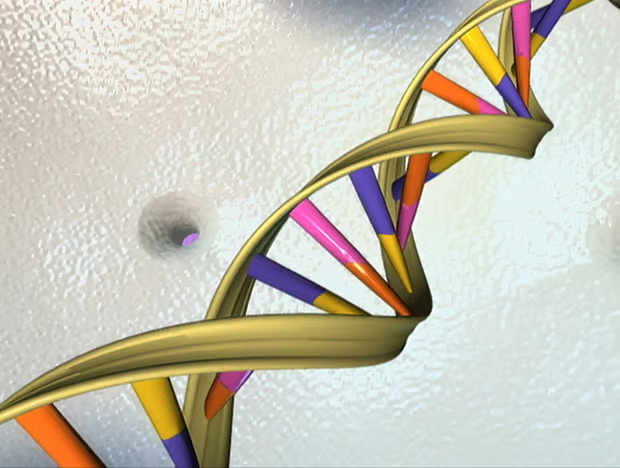
DNA is the molecule that contains the genetic information of an organism. It plays an important role in seeing the characteristics of parents in their children. It is the main component of chromosomes. Many people think that scientists James Watson and Francis Crick discovered DNA in the 1950s. However, in reality, it was first identified in 1869 by Swiss physician Friedrich Miescher. He identified it as the ‘nuclein’ in blood cells. Until Watson and Crick identified DNA, several other researchers worked on it. The nucleoin identified by Swiss physician Friedrich Miescher was later named DNA. DNA is the abbreviation of deoxyribonucleic acid. German biochemist Albrecht Kossel is credited with this name. Kossel later received the Nobel Prize. In 1953, James Watson and Francis Crick discovered the structure of double-stranded DNA. They both received the Nobel Prize in 1962 for this discovery. However, despite receiving the Nobel Prize, a few years later, there were allegations that they used the research data of chemist Rosalind Franklin without her permission. It was from her research that they got the idea about double-stranded DNA.
The idea that the Earth rotates on its axis and around the sun is now a very common thing. However, many people could not accept this theory of rotation given by scientists in the beginning. They were saying, how is the Earth rotating? Wouldn’t it be felt if the Earth rotated? However, after the continuous efforts of prudent scientists, it gradually gained acceptance. Several scientists played a role in discovering the theory of Earth’s rotation and gradually establishing it. One of the first to suggest that the Earth revolves around the Sun was the ancient Greek astronomer Aristarchus. However, this theory was not widely accepted in his time. Because, it was believed that the center of the universe, stars, planets and the Sun – all revolve around our planet Earth. Mathematician and astronomer Nicolaus Copernicus is credited with proposing the first heliocentric model of the universe. In 1543, he published his magnum opus, On the Revolutions of the Heavenly Spheres. Here, his theories are explained. One of these was that the Earth rotated on its axis to create day and night. Copernicus’ heliocentric model rejected the older Ptolemaic theory, which claimed that the Earth was stationary. Copernicus’ work was not widely known during his lifetime. It later gained acceptance. Galileo Galilei agreed with Copernicus’ theory. He proved it through observations using a telescope. In 1610, Galileo observed the phases of Venus and the moons of Jupiter. Through this, he gathered strong evidence against the geocentric model of the universe.
Galileo also proved that the various phases that Venus went through were due to its orbit around the Sun. German mathematician Johannes Kepler developed a series of formulas that detailed the orbits of the planets around the Sun. These formulas are still relevant today. These formulas provide mathematical equations to accurately predict the motion of the planets, consistent with the Copernican theory.
