
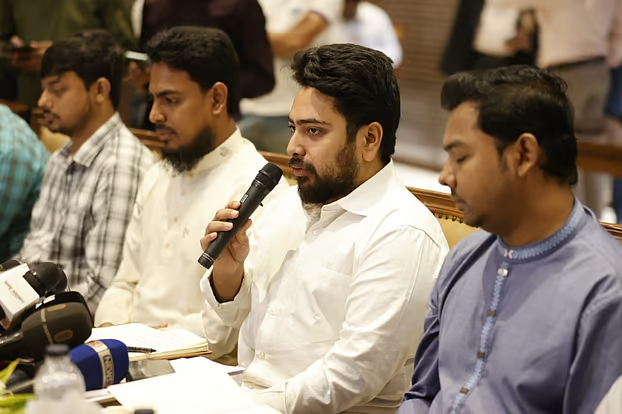
Another fascism, a dictatorial system will not come to Bangladesh, and we will move forward by blocking all its paths, said Nahid Islam, convener of the National Citizens Party (NCP).
He said these things in the opening speech of the NCP’s meeting with the National Consensus Commission. The meeting began at around 10:30 am today, Saturday, at the LD Hall of the National Parliament.
Nahid Islam said, “In the context of the mass uprising, our statement was that we want to abolish the fascist system and establish a new political settlement. In other words, the July mass uprising was not just about changing individuals, nor was it a plan to remove one party from power and install another. Rather, there was a desire to establish a democratic state that would protect the rights of the people by changing the quality of the state, through fundamental and qualitative reforms of the state structure.”
The NCP convener also said that his party has clearly said that by reform, they understand fundamental reforms. Explaining this, he said, ‘The reform that is being made will bring about a radical and qualitative change in the state structure. In the past, we have seen partyization in the constitution and state institutions. The seeds of an individual-centered structure were sown in the constitution. As a result, whoever is given the responsibility of running the state while keeping that state structure intact will also have fascist tendencies, a tendency to become autocratic.’
Nahid Islam said that the National Citizen Party is giving special importance to the constitution, the power of the Prime Minister, the judiciary, and the electoral system in terms of fundamental reforms of the state. He said, ‘We have given our opinions on the recommendations sent by the National Consensus Commission. In most cases, we have agreed, and in places where there is partial or disagreement, we have given our recommendations in a brief form. Maybe we will get an opportunity for detailed discussions today.’
Nahid Islam commented that national consensus and the July Charter are necessary. He said, “We have to fulfill our promise to the nation that another fascism, autocracy system will not come to Bangladesh, we will move forward by blocking all its paths. We will work from our respective places for a democratic state structure.”
At around 1:15 pm, NCP Member Secretary Akhtar Hossain spoke to reporters during the break in the meeting. He said, it is necessary to move towards elections by making justice and reforms visible. Elections must be held, but before that, justice and reforms must be made visible. The government can get the time it needs for this.
Akhtar Hossain said, “It is not possible to ensure a democratic environment with the current constitution. Rather, the Prime Minister has been given exclusive power here. Through that, there are opportunities for constitutionally establishing an autocracy. We are talking about the balance of power. We are talking about fundamental reforms of the current constitution.” We talked about the reality of the Constituent Assembly.’
Akhtar Hossain also said that the NCP has emphasized the need to reach a consensus in the process of transferring power not only on the basis of law-making in the existing political structure of Bangladesh, but also on the basis of coexistence and trust between political parties.
In response to a question from journalists, Akhtar said, ‘The word ‘election’ must be added in the name of the interim government or caretaker government. We have emphasized the responsibility of the caretaker or interim government during the election period. We are having a full discussion on what that outline could be, who could be there as advisors. We will be able to tell you in detail when the discussion is over.’
Hasnat Abdullah, the main organizer of the southern region of the NCP, said, ‘We are not asking for two elections. We are asking for one election, which is the election of the legislative assembly. At the same time, that election will be given the status of the Constituent Assembly.’
Only the Constituent Assembly has the jurisdiction to make basic fundamental reforms to the constitution, said Hasnat. He said, ‘That is why we want the legislative assembly election and the status of the Constituent Assembly at the same time in the upcoming elections. Their first task will be to rewrite the constitution. At the same time, the routine work of the parliament will be done.’
The BNP and NCP have differences on some recommendations. When asked by journalists how unity is possible in that case, Hasnat said, ‘Unity must be reached through discussions. Unity is not for party reasons but for national interests.’
Hasnat said that the meeting has discussed three issues so far. They are the rights of citizens, peaceful transition of power and Article 70 of the constitution.
When asked by journalists, NCP joint convener Sarwar Tushar said, “A person can be the Prime Minister for a maximum of two terms, we still adhere to that policy.”
Earlier, in his opening speech at the meeting, National Consensus Commission Vice-Chairman Professor Ali Riaz said that the possibility of a new Bangladesh has been created. Now our job is to build a new Bangladesh together. So that fascist rule does not return to Bangladesh.
